About · Who will work on your project
I build software by combining product thinking with engineering ownership.
If you bring me a project, you work with me directly. I read the code, make the technical decisions, write or review every change and answer your messages. There is no one in between.
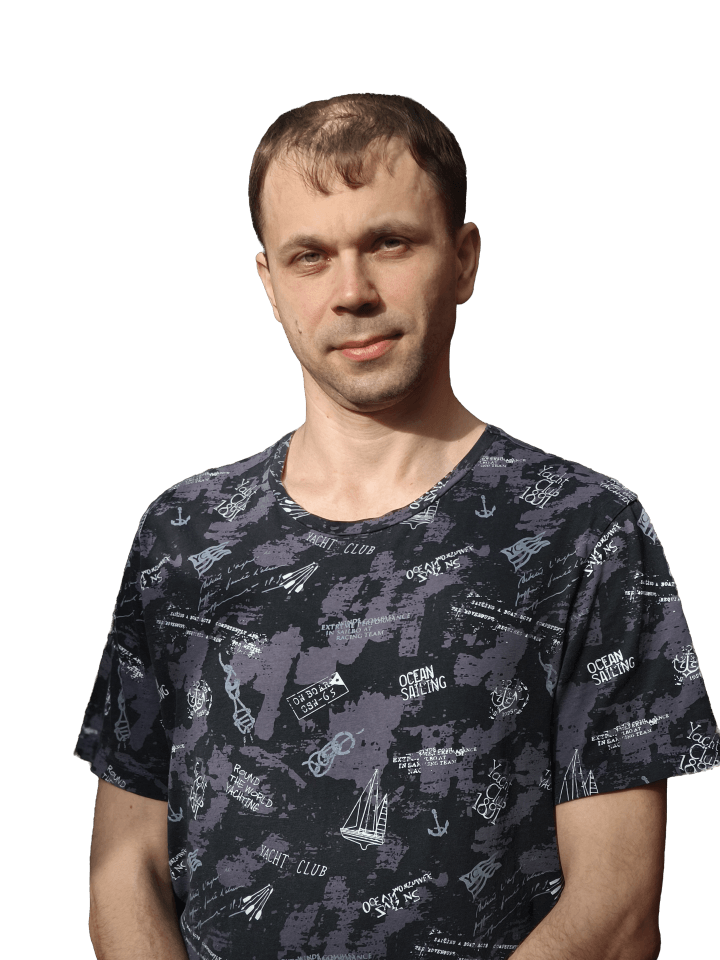
I'm a product-minded software engineer with 7+ years of hands-on development experience. My background includes backend systems, APIs, web applications, payment flows, authentication, integrations, internal tools and production troubleshooting.
Over time I became less interested in simply implementing isolated tasks and more interested in understanding the entire product: what problem it solves, how the system should be structured, and what is required to make it reliable in production.
Today I build my own SaaS products, publish open-source tools and help companies create or stabilize software systems.
Product decisions, architecture, code review and production quality stay with me. AI agents increase how fast that work reaches production.
Professional evolution
How I got to product engineering
Not a career timeline with logos on it. Each of these shifts moved the same line in one direction: from being handed a solution to implement, to deciding which solution is the right one. The phases below are how it happened.
-
Freelance web development
I started as a freelancer building simple websites for clients. That work taught me the skills no framework does: talking to people, hearing the need behind what they ask for, and turning a vague request into something they could use. It is also where I learned frontend for real.
-
APIs, backends and production
From websites I moved into systems: backend services, APIs, payment and authentication flows, integrations and internal tools. This is where I learned what production actually does to a design, and how much of software engineering is diagnosis rather than construction.
-
Owning whole products
I started asking what each feature was supposed to change for the business, and the answer usually showed that the requested solution was not the right one. That shift, from implementing tasks to shaping products, is the one that mattered most.
-
Architecture and production ownership
I took responsibility for what happens after the deploy: system boundaries, failure paths, observability, the on-call reality of a system nobody wanted to maintain. From then on I counted a feature as finished only when it held up in production.
-
Building my own
The next step was products of my own, born from problems I hit in my own work. I shipped open-source libraries and self-hosted tools and I'm building SaaS. Publishing them meant owning product definition, positioning, documentation and release management, not only the code. The products page has the full list.
-
Independent builder
I build my own SaaS products, publish open source, and take on selected work: building products, automating operations and rescuing software that stalled. I work globally. The AI-assisted workflow behind it is what lets one engineer cover the ground a small team used to.
The through-line is narrow enough to state in one sentence: I did not stop being an engineer, I stopped treating the requested solution as the definition of the problem. The questions I used to raise from outside the decision (why build it this way, what happens in this case, this will not actually cover the problem) are the job now rather than an interruption to it.
How I work with AI
AI agents are a development team. I am still the engineer.
The working model as it actually runs, including where it does not help.
I own
Product and architecture
What the system is for, where its boundaries sit, what it will not do, how the data is modelled and how it fails. These decisions are not delegated, because they are the ones that are expensive to reverse.
Agents do
Implementation at volume
Inside a defined boundary, AI agents write code, tests and migrations faster than I can alone. That is a real increase in capacity, and it is the reason a single engineer can now ship a system that used to require several.
I own
Review and production quality
Nothing reaches production without my review. Generated code is confident, fluent and indifferent to whether it is correct, so the review is not a formality, it is where the engineering happens.
AI increases my production capacity. It does not replace engineering ownership.
Roman Golovanov
Links
Where to look next
The code is the most direct answer to most questions about how I work.
Have something that needs fixing, automating or building?
Tell me what the situation is: software that stalled, a process that runs on manual work, or a product to build. Within one working day I'll tell you whether I'm the right person for it.
Hiring for a senior or founding role? Here is what I'm looking for.